Not to be outdone by time constraints, I had tried to cover as much as I could of Xiamen within 3 days. I first visited a beautiful islet called Gu Lang Yu, famous for its high piano population and rich European architectural style.
 The red house shown below is a legacy of the islet's past as the prominent site of European embassies during the Qing Dynasty. Like the hundreds of its kind on the islet, it has now become a residence of the common folk after 1949.
 The islet is a pleasant place to be in, and indeed it had attracted many influential Chinese of the past to house their residences here. There is a pavilion atop the highest point of the islet, where a skyline view of opposite Xiamen can be obtained. An image of Zheng Chenggong looms near, symbolic of a successful takeover of Taiwan during the Ming-Qing period. It is up to the visitor to decide if it continues to bear any significance as a contemporary.
 I hopped onboard a cab to Xiamen University, known as the most beautiful tertiary campus in mainland China. For me, it has to be the most beautiful campus that I have ever visited in the country, followed by Peking University by my own standards.
 At the risk of stating the obvious, Xiamen University was founded by Tan Kah Kee. Mini-museums, monuments, statues and buildings bearing his name are scattered all over the campus, adding a nostalgic touch to the picturesque campus.
 I stumbled upon a calm and peaceful pond where couples populate by its circumference. By the way, the air is fresher and less polluted in Xiamen than in most other Chinese cities, so it had been a pleasant experience strolling the pathways and roads.
 After a while, I decided to get in touch with my material side by going to Zhongshan road, the equivalent of our Orchard Road. The variety of goods and services offered there is decent, not to mention the abundance of discs and more discs.
 I realized that I had to fulfil my spiritual needs as well. Off I went to a hilltop temple the next morning. The history of this temple can be traced to as early as the Jin Dynasty.
 And then at noon, I prayed at the most famous temple in Xiamen known as Nan Pu Tuo (南普陀). It was established in the Tang Dynasty and had enjoyed imperial patronage for many generations. The vegetarian biscuits and dishes served were superb, so it does not seem too bad an idea to seek monkhood at the temple.


 I was overwhelmed with joy when the “青天白日”flag greeted me from afar. I had wanted to salute it but I reckoned that if I did, I might not have returned home alive.
 The “三民主义统一中国”tablet on the Dadan island was erected by Chiang Ching-kuo to rally all Chinese under the principles expounded by Sun Yat-Sen. The words were big enough to be seen using a pair of binoculars along the Xiamen coastline. He was frustrated at the fact that Taiwan had been expelled from the United Nations.
 In a nutshell, I was busy snapping photos of the temple, its architecture, offerings, devotees, altars, idols etc. I had also participated in an annual festive procession to celebrate the celestial birthday of the City God. Again the best pictures of the grand carnival of enacted deities and teeming crowds are left in the hi-pro camera.
 Nothing was left to be done at night, so some of the uncles in my tour group decided on something that cannot be done legally in our local context. Here's a glimpse at our arsenal:


 We also went to the Tiananmen Square. "Forward, Comrades!" seemed to be the cry for the Monument to the People's Heroes.
 Of course, how could I have missed the sentry guards standing on alert near the Great Hall of the People? However, it was a pity that I failed to catch the changing of guards parade, as well as the hoisting of the China flag accompanied by the Chinese anthem in the wee hours of the morning.


 Still, I managed to catch a glimpse of the Dragon Throne! Most Qing Emperors had sat on the Throne. I wish to sit on it too.
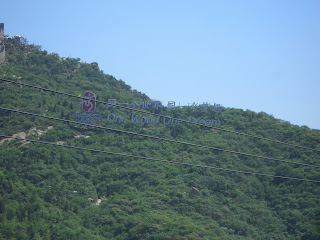
 Of course, we climbed the Great Wall. It was my nth time as a 好汉. The scorching sun and heat had almost killed us all. Singapore could have lost a number of talents.
 "One World, One Dream". Tell the barbarians that when they scale the walls again.
 The 13 Ming Tombs is represented by an excavated one that belonged to Ming Shenzong, more commonly known as the Wanli Emperor. The underground mausoleum is splendid with grandeur. The following picture that I have was taken on the ground, and it features the Chinese impression of a mythical creature known as the "Qilin" (麒麟).


 Later in the morning, we went to the Guangzhou Museum, and for a history buff like myself, it was definitely a welcome treat. I learnt about the early history of Guangzhou, starting from the Nanyue Kingdom, to the Panyu city, to the Nanhai trade, to the Shi Xie regime, to the links with North Vietnam, to the Canton trade system, and finally to the modern city that we see now. I took many pictures of the relics exhibited at the Museum.
 To wrap up the day, we toured the old streets of Guangzhou to catch a glimpse of what life might have been in the past. However, the streets teemed with shops and shoppers, and they displayed a distasteful blend of traditionalism and commercialization.


 I concluded the day by meeting up with Kieron, a friend from the Hong Kong University. We knew each other in Taiwan last year during a competition. Kieron offered me a treat at a Japanese restaurant at Tsai Wan, and we went for mango dessert at my favourite 许留山 outlet at Causeway Bay where I broke a shoe. That spells the intensity of my Hong Kong trip. Thanks to Kieron's discount card, I was able to buy a new pair of New Balance shoes for less than SGD 50 at a nearby shop. An added contribution to the already-robust Hong Kong economy!
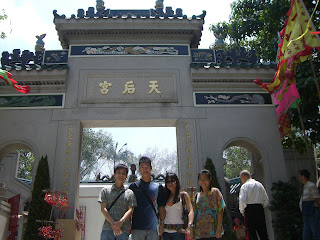
 Besides having a beautiful landscape, which I had enjoyed viewing immensely, Lamma Island is also known for its fresh, delectable seafood. What may be less known is that Lamma Island is actually the birthplace of movie star Chow Yun Fatt, who had famously quipped "Welcome to Singapore" in the recent Pirates of the Carribean III. In short, Lamma Island provides a great escapade from the urban hassles of ever-busy Hong Kong.

